Much of the information available about hardwood floor finishes can feel contradictory. There is a simple reason for that: unlike furniture, appliances, or phones, floor finish is difficult to see, touch, or compare before it is applied.
Two floors can use the same finish and still perform very differently. The final result depends on the finish product, the sanding quality, the number of coats, the spread rate, the cure time, and how the floor is used after the project is complete.
This article explains what affects hardwood floor finish durability and how to decide whether a high-traffic finish, an additional coat, or both make sense for your home.
Before Comparing Finish Options, Application Quality Matters
Before comparing high-traffic finish and additional coats, it is important to understand that the finish must be applied correctly. A premium finish applied too thin, over a poorly sanded surface, or without proper dry time may underperform.
We cover sanding quality, cure time, applicator choice, and spread rate in more detail here: Why Hardwood Floor Finish Durability Depends on Sanding and Application Quality.
High Traffic Finish vs More Coats of Finish
High-traffic finish and additional coats are complementary, not competing options. They can be selected separately or together, and each improves durability in a different way.
A high-traffic finish improves the quality and resistance of the coating itself. An additional coat increases the amount of protective finish on the floor.
High Traffic Finish
When we talk about high-traffic finish, we are usually talking about a category of 2-component waterborne finishes. These finishes come with a separate hardener that is mixed into the finish shortly before application.
The hardener helps create a tougher cured coating. This can improve resistance to scuffing, abrasion, moisture exposure, household chemicals, and harsh or acidic spills.
In simple terms, high-traffic finish refers to the quality and strength of the protective coating.
Additional Coats
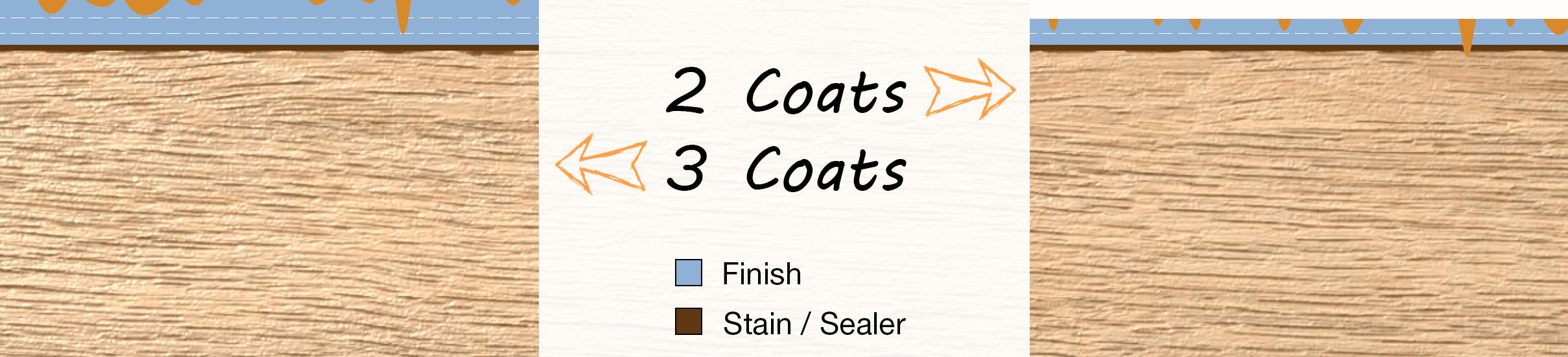
The number of coats directly affects the final thickness of the protective coating. All else being equal, a thicker cured film gives the floor more protective material to wear through before traffic reaches the wood.
This is why an additional coat can meaningfully extend floor life. It does not change the quality of the finish itself, but it increases the thickness of the protective wear layer.
When applied correctly, a floor with two coats of finish may have a cured coating thickness of approximately 1.86 mils. With three coats, that thickness may increase to approximately 2.94 mils. In this example, the third coat creates about 58% more protective film thickness.
Because finish wear happens from the top down, that added thickness usually translates into longer service life before the floor begins to show wear or needs another maintenance coat. The exact number of additional years depends on traffic, pets, grit, cleaning habits, and maintenance, but the durability advantage of the extra coat is real.
How did you arrive at these numbers?
Let’s use a simplified example.
One gallon equals 231 cubic inches. If a finish is applied at 550 square feet per gallon, that equals 79,200 square inches of floor area.
That means the wet layer thickness is:
231 ÷ 79,200 = 0.00292 inches
That equals approximately 2.92 mils of wet film thickness. A mil is 1/1000 of an inch.
If the finish has 37% solids content, the fully cured dry film thickness would be:
2.92 mils × 37% = 1.08 mils per coat
However, part of the first coat is affected by wood absorption and grain raise, and some of that material is reduced during abrasion between coats. For this example, let’s estimate that loss at 0.3 mils.
Using those assumptions:
- Two coats: 1.08 mils × 2 − 0.3 mils = 1.86 mils
- Three coats: 1.08 mils × 3 − 0.3 mils = 2.94 mils
In this example, three coats create approximately 58% more cured film thickness than two coats.
Because finish wear happens from the top down, the added film thickness gives the floor more material to wear through. In practical terms, this may translate to roughly 6.5 additional years in a relatively low-traffic home, or around 3 additional years in an average household.
These are not absolute guarantees. They are relative estimates based on added film thickness. Actual results depend on traffic, pets, grit, cleaning habits, moisture exposure, and maintenance.
How Many Coats is Enough?
The right number of coats depends on the household.
Most finish manufacturers require a minimum of two coats to seal the wood effectively and create an even finish capable of repelling spills. For many low-traffic homes, two properly applied coats may be enough, especially when the floors are maintained well.
However, three coats are often a better choice for homes with heavier use. This includes families with children, pets, frequent guests, high-traffic kitchens, stairs, hallways, and rental properties.
There is no universal number of years a finish will last. A retired couple without children or pets may get many years from two coats of a quality finish. A busy rental home can wear through three coats of high-traffic finish in only a few years if the floor is abused or poorly maintained.
As a general rule, consider how long you plan to live in the home and how hard the floors will be used.
- If you plan to move in a few years, two properly applied coats with good maintenance may be enough.
- If this is a long-term home, three coats are usually a smarter investment.
- If the floor has pets, stairs, kitchens, or heavy traffic, three coats of a high-quality finish is usually the better option.
Our Recommendation
A high-traffic finish improves the strength and resistance of the coating itself. An additional coat increases the amount of protective material on the floor. These upgrades are complementary, and together they provide better protection than either option alone.
For homes with pets, children, stairs, busy kitchens, frequent guests, or long-term ownership plans, the best option is usually High Traffic Finish + Additional Coat. This gives the floor both a stronger finish system and a thicker protective wear layer, helping delay the next maintenance coat or full refinishing project.
If budget is limited, choose the upgrade based on the main concern:
- Choose High Traffic Finish if the main concern is pets, kids, spills, scuffing, or harsher daily use.
- Choose an Additional Coat if the main concern is adding more total wear layer and extending the time before the floor needs more work.
If neither upgrade fits the budget, two properly applied coats of a quality finish can still protect the floor for several years with good maintenance. The upgrades are simply a way to improve durability for homes that need more protection or for customers who want a longer-lasting finish system.