When we talk to homeowners about finish options, one question comes up a lot: is it better to upgrade to a high-traffic finish, or is it better to add another coat of finish?
The honest answer is that they do different things. A better finish improves the strength of the coating itself. An extra coat increases the thickness of the protective layer on top of the wood.
That means one option is not automatically a replacement for the other. They can be selected separately, or they can be selected together. The right choice depends on how the floors will be used, whether you have pets or kids, how much traffic the home gets, and how long you want the finish system to last.
First, the Finish Has to Be Applied Correctly
Before comparing upgrades, it is worth saying this clearly: any finish can underperform if it is applied poorly.
A premium finish applied too thin, over a poorly sanded surface, or without proper dry time is not going to perform the way it should. The brand of finish matters, but the sanding, spread rate, applicator, dry time, and cure time matter too.
We cover that topic in more detail here: Why Hardwood Floor Finish Durability Depends on Sanding and Application Quality.
Better Finish vs. Extra Coat: The Simple Difference
The easiest way to think about it is this:
High-traffic finish gives you a stronger coating.
An extra coat of finish gives you a thicker wear layer.
Both help durability, but they help in different ways.
A high-traffic finish is about the quality and toughness of the finish. An extra coat is about how much finish is actually on the floor for traffic to wear through.
In homes with dogs, children, stairs, busy kitchens, or heavy daily use, the best result is often both: a stronger finish system and a thicker protective layer.
What a High-Traffic Finish Does
When we say “high-traffic finish,” we are usually talking about a 2-component waterborne finish. These finishes come with a separate hardener that is mixed into the finish shortly before it is applied.
That hardener helps the finish cure into a tougher coating. In real life, that can help with scuffing, abrasion, moisture exposure, household chemicals, and acidic spills.
This does not mean the floor becomes scratch-proof. No hardwood floor finish does that. But a better finish can hold up better to daily use than a standard finish, especially in busier homes.
So, in simple terms, high-traffic finish improves the quality and strength of the coating.
What an Extra Coat of Finish Does
An extra coat works differently. It increases the final thickness of the protective coating.
Hardwood floor finish wears from the top down. So the more cured finish there is on the floor, the more material traffic has to wear through before it reaches the wood.
This is why an extra coat can make a real difference. It does not make the finish itself stronger, but it gives the floor more protective film thickness.
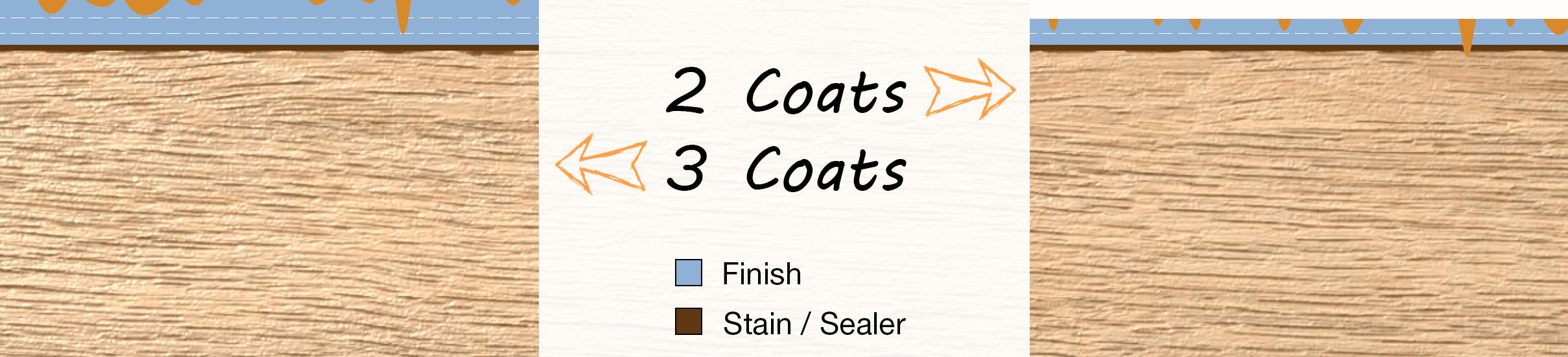
When applied correctly, a floor with two coats of finish may have a cured coating thickness of about 1.86 mils. With three coats, that thickness may increase to about 2.94 mils. In this example, the third coat adds about 58% more protective film thickness.
That added thickness is not just a technical detail. It is the reason an extra coat can help the floor last longer before wear starts to show or before a maintenance coat is needed.
Fig 1. An illustration of finish coating thickness and its effect on durability.
Where the Thickness Numbers Come From
Here is the basic math behind the estimate.
One gallon equals 231 cubic inches. If a finish is applied at 550 square feet per gallon, that equals 79,200 square inches of floor area.
That gives a wet film thickness of:
231 ÷ 79,200 = 0.00292 inches
That is approximately 2.92 mils of wet film thickness. A mil is 1/1000 of an inch.
If the finish has 37% solids content, the cured dry film thickness would be:
2.92 mils × 37% = 1.08 mils per coat
Some of the first coat is affected by wood absorption and grain raise, and some material is reduced during abrasion between coats. For this example, we estimate that loss at 0.3 mils.
Using those assumptions:
Two coats: 1.08 mils × 2 − 0.3 mils = 1.86 mils
Three coats: 1.08 mils × 3 − 0.3 mils = 2.94 mils
That makes the three-coat system about 58% thicker than the two-coat system in this example.
Because finish wears from the top down, that added thickness gives the floor more material to wear through. In practical terms, this may translate to roughly 6.5 additional years in a relatively low-traffic home, or around 3 additional years in an average household.
Those numbers are not guarantees. No one can honestly guarantee exactly how many years a finish will last in every home. Pets, grit, cleaning habits, moisture, furniture, rugs, and daily traffic all matter. But the relative benefit is real: a thicker finish layer gives the floor more wear capacity.
How Many Coats Are Enough?
For most floors, two coats is the minimum needed to seal the wood and create a usable protective finish. In lower-traffic homes, two properly applied coats may be enough, especially if the floors are maintained well.
Three coats make more sense when the floors are going to work harder. That usually includes homes with dogs, children, stairs, busy kitchens, hallways, frequent guests, or rental use.
We have seen both sides of it. A quiet home with no pets can get many years from two coats of a quality finish. A busy rental or a home with large dogs can wear through a stronger finish much faster. The house matters. The people living in it matter. The maintenance matters.
As a general rule:
If you only need the floor to perform for a few years, two properly applied coats may be enough.
If this is a long-term home, three coats are usually a better investment.
If the floor has pets, stairs, kitchens, or heavy traffic, three coats with a high-quality finish is usually the safer choice.
Which Option Should You Choose?
If budget allows, the best option for busy homes is usually High-Traffic Finish + Extra Coat.
That gives the floor both advantages: a stronger finish and a thicker protective wear layer. It is the option we are most comfortable recommending when someone wants the floor to last as long as reasonably possible before the next maintenance coat or full refinishing project.
If budget is limited, choose based on the main concern:
Choose High-Traffic Finish if you are more worried about pets, kids, spills, scuffing, or harsh daily use.
Choose an Extra Coat if you are more worried about adding total wear layer and extending the time before the floor needs more work.
If neither upgrade fits the budget, two properly applied coats of a quality finish can still protect the floor for several years with good maintenance. The upgrades are not mandatory for every home. They are simply ways to improve durability when the floor needs more protection or when the homeowner wants a longer-lasting finish system.
Comments